

CASE STUDY 03 · MULTI-TENANT SAAS FOR DRIVERS & CAR SERVICES
Elevate Rides

A booking and dispatch platform for private drivers and small car services, built around one shared, synced version of every trip.


THE PROBLEM
Everyone was working from a different version of the same trip.
Small car services run on phone calls, texts, paper logs and dispatch apps that hide the details that matter. Customers, dispatchers and drivers all touch the same trip through very different screens.
When a detail gets lost between them, the cost is real: failed pickups, one-star reviews and money the owner never sees coming.
RESEARCH
4 interviews, 4 very expensive stories.
I talked to a former limo company owner, two rideshare drivers and a limo agency driver, then mapped what they told me on an affinity board.
$90K
estimated seasonal loss from one miswritten phone number
Owner estimate, self-reported
$20K
in chargebacks pushed the owner to accept cash only
Owner interview
10–15s
to accept a trip while driving, with penalties either way
Driver interviews
What I heard
- Insight 1 · Drivers manage their own radius, hours and vehicle limits by hand, and get penalized for turning down trips that don’t fit.
- Insight 2 · Ride notes lived behind a second tab, so drivers missed accessibility needs and vehicle requirements.
- Insight 3 · One miswritten phone number meant a failed pickup, and nobody could see the full price split behind a fare.
See the synthesis
USER FLOW
One trip, three roles, one source of truth.
Every feature traces back to a finding from the four interviews. The flow follows one trip, from the moment an operator takes the booking to the record they keep for audits.
OPERATOR
DRIVER
RECORD
WIREFRAMES
From sketch to screen.
I moved from low-fidelity flows for each role to mid-fidelity screens, then to high fidelity with the Elevate Rides brand.
LOGO & BRAND DESIGN
A brand that every car company can wear.
I also designed the Elevate Rides logo and visual identity. It had to feel premium enough for limo owners and clear enough for a driver glancing at a phone between trips.
Because each company gets its own branded booking page, I built the identity to flex: one platform look, with room for each operator’s own name and color.
THE SOLUTION
The solution
SOLVES INSIGHT 1
Driver service profile
Drivers set their working radius, hours and vehicle capacity up front. Dispatch only offers trips that fit.
SOLVES INSIGHT 2
Every trip detail before accepting
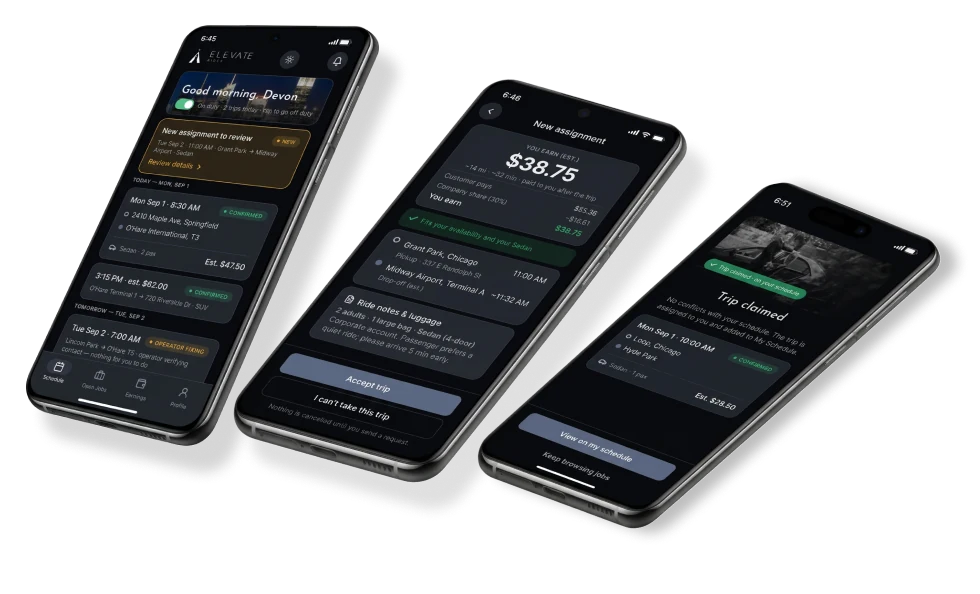
Pickup, drop-off, distance, payout and ride notes all live on the main trip card, with a fair window to decide and no penalty for saying no.
SOLVES INSIGHT 3
One synced trip, two-sided updates
Verified phone and address at booking, a fare breakdown showing what the customer pays, the company’s share and the driver’s payout, and automatic status updates to both sides.
A CLOSER LOOK
Look into the app
Pickup and drop-off
With distance and estimated time.
Ride notes
Accessibility needs and vehicle requirements on the main card.
Payout breakdown
Customer price, company share and your payout.
Accept or decline
A fair window to decide, with no penalty for saying no.
BEFORE USABILITY TESTING
Scope at a glance
3
user roles designed on one platform
10
must-have features traced to interview findings
1
shared source of truth for every trip
- I sorted 23 ideas by evidence: 10 must-haves, 7 might-haves and 6 for a future version. Only features tied to an interview finding made the first release.
- “Do you want this ride, yes or no?” That is all Dave, a former limo company owner, wanted dispatch to ask. It became the trip offer. Rider preferences and trip details were missing too, which hurt personalized service, so they now live on the trip card.
- Next step: a usability test where customers complete a booking and drivers manage a ride, to validate the trip card and fare breakdown.
Everyone was working from different versions of the same trip. One shared, synced source of truth fixes most of it.
WHAT’S NEXT
What’s next
Verified card payments that take chargeback risk off operators, ride handoff within a fleet, mileage and expense tracking, flight tracking for airport pickups, and an earnings dashboard drivers can check between rides.
What I’d do differently
Test the trip card with real drivers before polishing the brand.

NEXT CASE STUDY
OsombaDesigning AI search for low-literacy, low-bandwidth buyers in the DRC.